
221Days
02Hours
47Minutes
24Seconds
Save the Date:
29th Annual ICMAC,
July 16-18, 2027
Chinese Martial Arts (CMA) have a rich history that spans thousands of years. During this time the CMA landscape has evolved into hundreds of different styles. While you can find certain common principles and techniques among the different systems, there are still great differences between the Northern and Southern schools and the Internal and External Chinese martial arts styles. In order to present a fair competition for all athletes, we have established rules and criteria that govern ICMAC tournaments.
WUSHU will be run under ICMAC Rules. This includes ring size, categories, skill levels and age groups. The only exception is compliance with the type of weapon used in international events. This is not an IWUF competition, and we ask all participants to abide by the categories listed on the ICMAC Division Sheet.
Unsportsmanlike conduct by any competitor, parent, or coach, or the use of abusive language, will result in disqualification of the competitor with NO REFUND.
NOTE: We reserve the right to refuse any registration.
Traditional Chinese Martial Arts and Contemporary Wushu: Any cotton or silk Chinese-styled uniform with frog buttons. Song Shan Shaolin, Wudang and Southern Style (sleeveless) uniforms are acceptable. T-shirts may be worn for Reaction Skills (Sparring, Push Hands, and Chi Sao). Martial arts type shoes are required in forms and weapons divisions. Our goal is to provide a friendly but disciplined competition environment, so we urge all participants to follow the uniform guidelines.
All competitors must be present for the opening ceremony. Therefore, we recommend that if you plan to register onsite, you must do so on Friday or early Saturday so that you will not be delayed. There will be NO onsite registration for Sparring, Push Hands, Chi Sao, and other Reaction Skills.
Adult Competitors may register in a lower age group if they wish to compete in categories not available in more senior age brackets. (Please contact our office for approval.) However, once you chose to compete in a lower age bracket, all of your divisions must be in that bracket. Competitors must register for all their divisions at the same skill level and age group.
The first to register is the last to go.
Competitors will be listed in accordance with their date of registration; the earlier your registration is submitted, the lower you will be placed on the performance list.
When called to perform, Competitors will walk to the place on the competition floor where they will begin their form and greet the Chief Judge with a recognized salute or bow. Upon being acknowledged by the Chief Judge, Competitors will return to attention and begin their form within 5 seconds.
Upon completing their form, competitors must once again come to attention and salute the Chief Judge. Competitors will wait to receive the scores, then perform one final bow toward the Chief Judge and walk off the floor.
The Open Palm and Fist Salute is widely recognized in Chinese martial arts and is the required salute for ICMAC Tournaments.
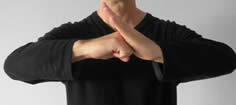
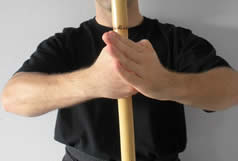
All the requirements cited for the empty hand forms salute apply to the salute with weapons. In addition, each weapon has its own requirements. The salute with the staff and the spear requires the competitor to hold the weapon with the right fist covered by the left palm. The Pu Dao, Quan Dao and other long weapons also use this same salute.
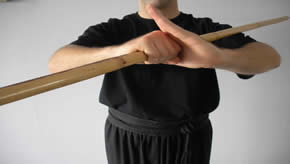
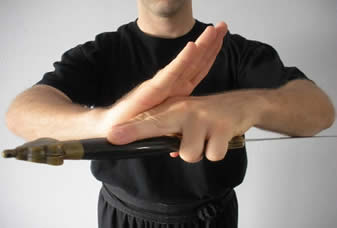
The salute with the broadsword requires the competitor to hold the weapon in the left hand and cradled in the crook of the elbow. Salute by covering the hilt with the right palm. Double broadswords, other similar single-edge weapons and the three-sectional staff will also use this salute.
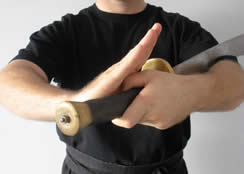
The salute with the straight sword requires that the sword be tucked under the left forearm. Salute by covering the hilt with the right palm. Double swords and two-handed sword will also use this salute.
We do not base the skill level criteria on belt or sash colors since every school has different standards and color schemes. To be fair, our skill level criteria are based exclusively on the length of training or accumulated training. Competitors must register for all their divisions at the same skill level and age group.
To provide a competitive environment, we reserve the right to combine divisions with fewer than five competitors with the next closest skill level and age group. At our discretion, we may combine divisions with the next level or combine Boys and Girls, Men and Women.
Where 4 Categories:
Novices cannot compete with forms that contain tornado kicks, aerial techniques and splits.
Where 3 Categories:
Where 2 Categories:
NO Time Limits for Kids and Juniors. All times are given in minutes. A penalty of 0.2 points will be deducted for each infraction of 5 seconds or partial increment thereof.
NOTE: For Tai Chi and Liuhe Bafa, it may be necessary for two or more competitors to perform simultaneously.
Tai Chi Standard Forms are performed to completion (no time limit). These forms MAY NOT be performed in other Tai Chi divisions and DO NOT qualify for Grand Champion. These forms include Yang Style Tai Chi 16 Hand Form, Yang Style Tai Chi 16 Sword Form, Yang Style Tai Chi 24 Hand Form, Yang Style Tai Chi 32 Sword Form, and the Tai Chi 42 Standardized Competition Hand Form and Tai Chi 42 Standardized Competition Sword Form. With large groups, two competitors may have to perform simultaneously.
In Traditional Categories, Novices and Beginners are not subject to Minimum Time Requirements. Maximum Time applies to Teens and Adults.
Northern Long Fist: Competitors can begin their form in any quadrant of the competition ring. The form must end in the same quadrant as the starting point*. Forms that end by facing opposite of the starting point will result in a .5 point deduction from the final score. Forms that do not end in the same quadrant as the starting point will result in a .2 point deduction* from the final score. Interruptions caused by uncontrollable circumstances will not be penalized.
*Competitors whose form does not end in the same quadrant must inform the Chief Judge before performing. No penalty will be assessed in such circumstances.
The basic 32 Wushu forms are part of many traditional curriculums. The 32 Saber, 32 Staff, 32 Sword, and 32 Spear may be performed in all Novice divisions, and in Beginner divisions where there is no Novice category. This applies to all age groups.
Re-performing due to forgetfulness will result in a .5 point deduction from the final score. The only exception is for Novice and Kids & Juniors Beginners category. Forgetting a form twice results in disqualification (Novice & Beginners get penalized 1 full point).
Over or under time limit results in a deduction of 0.2 for each infraction of 5 seconds or increment thereof.
Broken weapons will result in a .5-point deduction from the final score; this applies to all skill levels. A dropped weapon will result in a .5–point deduction for Novice and Beginners and a 1–point deduction in all other categories. Dropping a weapon twice will result in disqualification; this applies to all skill levels. Striking or cutting oneself with a weapon is a .5–point deduction (multiple striking or cutting will result in multiple deductions).
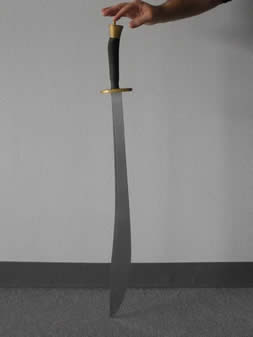
All sabers and swords used in the Traditional Divisions must be of Loong Quan type steel or heavier steel; the weapon must be able to sustain its own weight when placed on its tip. This requirement does not apply to Kids divisions (ages 9 and under). No Wushu type weapons may be used in the Traditional Divisions.
Deductions are made only by the Chief Judge and are deducted from the Final Score. Side Judges must keep track of the infractions when scoring but the Penalty Deductions are implemented ONLY by the Chief Judge.
 |
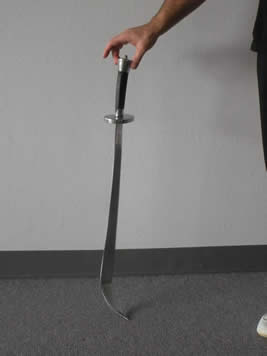 |
| Acceptable | Unacceptable |
Long Weapons such as the Quandao and Pudao are also subject to these requirements.
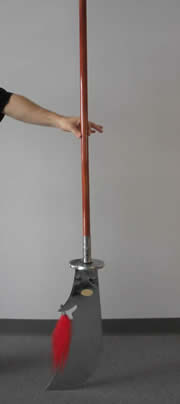
Wushu Weapons Divisions require the current standard weapons used in international competition (IWUF).
Non-compliance with these weapon standards will result in a .5 point deduction from the final score unless otherwise specified.
Weapons require a certain length in order to be used efficiently. The requirements, with few exceptions, are generally the same for Traditional and for Contemporary Wushu. The length of the weapon is determined by the competitor’s height.
1 – Saber & Swords: The minimum length for the saber and the straight sword requires that the tip of the weapon reach the competitor’s top of ear when held at the sides.
Note: All other Short Weapons, other than Saber and Sword, fall in the Other Weapon Category, for example, Fan, Stick, Kan Dao etc.
2 – Staffs and Spears: Staffs can vary in length from a minimum of the height of the competitor’s eyebrow to well over the competitor’s head. Staffs shorter than the competitor’s eyebrow fall into the Other Weapons category. In divisions where there are no Other Weapons, any length staff or stick may be used.
Note: Spears vary in length between Traditional Northern and Southern Systems and Contemporary Wushu. For Northern Systems the spear should reach the tip of the competitor’s fingers when the arm is stretched overhead. For Southern Systems the spear can be slightly shorter but the spear tip must be above the competitor’s head. For Wushu the Spearhead should be above the competitor’s fingertips when the arm is stretched overhead.
3 – Flexible and Double Weapons: All Flexible Weapons and Double Weapons fall into the Other Weapons Category unless we feature a division for these Weapons.
Note: Traditional weapons like Double Saber, which contain ground-rolling techniques, are not bound by the two-acrobatic technique restriction. The same applies to Traditional Monkey Staff (but not to the Wushu Monkey Staff).
For Wushu the Spearhead should be above the competitor’s fingertips when the arm is stretched overhead.
For all Novice and Beginner Divisions, weapons are classified in Short and Long Categories only. In addition, for Kids divisions (ages 7-9) at all skill levels, weapons are classified in Short and Long.
Long Weapons Category for Novices and Beginners includes all weapons that extend above the Competitor’s shoulders (Spear, Staff, etc).
Short Weapons Category for Novice, Beginner, and Intermediate includes Saber, Sword, Double Daggers, Short Stick, Fan, and Nunchaku.
Weapons that are not allowed in the Novice category are the following: Quandao, Double Sabers, Double Hooks, Double Swords, Chain Whip, 3-Sectional Staff, Rope Dart and other exotic weapons not listed above. If a competitor is skillful enough to compete with any of these weapons, then they cannot be considered a Novice.
Categories for Little Dragons (ages 6 & under), Kids (ages 7-9), and Juniors (ages 10-12): The Forms will include both Northern and Southern styles and cannot incorporate more than one acrobatic skill.
Categories for Teens (ages 13-17): The forms will include Northern and Southern styles for Novices and Beginners. For Intermediate and Advanced, Northern styles and Southern styles have separate hand forms and weapons forms divisions.
Categories for Adults: The Novice and Beginner Forms divisions will include Northern and Southern styles. Hand forms that incorporate more than one Acrobatic Skill must be entered in the Open Hand Forms category in the Intermediate or Advanced Divisions. Note that for Advanced Grand Champion competitors, Open Hand Forms DO NOT qualify.
Categories for Intermediate and Advanced Adults (ages 18-35): divisions will be broken down as follows:
Traditional Northern includes Long Fist styles such as Eagle Claw, Mizong, Cha Quan, Hua Quan, and Northern Shaolin Styles.
Northern Other includes styles such as Praying Mantis, Fanzi, Baji, Pigua, Tongbei, Snake Style, and other non-acrobatic styles.
Northern Open includes acrobatic styles such as Drunken and Monkey, and any other form that has more than one acrobatic technique (such as Butterfly Kicks, Cartwheels, Aerial Cartwheels, Kip-ups, Front and Back Handsprings, and Splits). Hand forms that include more than one acrobatic technique, DO NOT qualify for Grand Champion, and must be entered in Open Divisions.
Traditional Southern includes Choy Li Fut, Hung Gar, Hop Gar, Jow Gar, Southern Dragon Fist, Pak Mei, Wing Chun, Five Ancestors Fist, and similar styles.
Partner Forms: There are separate categories for Hand and Weapons forms. (mixed teams with boys and girls, men and women are allowed). Partners must be in the same age group (ages 12 & under, 13-17, 18 & over), and both partners must register. No onsite registration for partner forms.
For exceptions or questions, please contact [email protected].
Medals will be awarded from 1st through 3rd place in each division.
No ties are allowed at any level since placements reflect a competitor’s overall standing. Tie-breaking procedures will go into effect to determine the winner.
Competitors must pre-register to compete in Push Hands. No onsite registration will be accepted for Push Hands, Sparring, Chi Sao or other Reaction Skills. If you register for Push Hands, you cannot also register for Chi Sao or Sparring.
Fixed Step: Both feet must remain in contact with the floor at all times. Heel or toe may be raised briefly, but the foot may not leave floor or change position.
Restricted Step:
Free Style:
The following descriptions for Competition Format, Match Area, Objective of Match, Progression of Match, etc., apply to both Fixed and Restricted Step Push Hands.
Competition format:
Match area:
Objective of match:
The objective of the match is to uproot and off-balance the opposing player while maintaining own root and balance using Taijiquan (Tai Chi) principles.
Progression of match:
Play is begun in a neutral position with backs of right wrists touching. Left hands are placed on (not under) right elbow of opponent. (Reversed in second period.)
Continuous Contact
Valid techniques:
Pushing, pulling with one hand, trapping techniques, non-impact techniques that cause opponent to lose balance, and single-hand grabbing techniques that cause opponent to lose balance.
Target Areas:
Contact is permitted between the hips and collarbone.
Note: The head, neck, spine, and legs may not be attacked and will result in a warning or disqualification depending on the severity of the infraction.
Scoring:
Warnings:
The following will result in immediate disqualification:
Competitors must pre-register to compete in Chi Sao. No onsite registration will be accepted for Chi Sao, Sparring, Push Hands, or other Reaction Skills. If you register for Chi Sao, you cannot also register for Push Hands or Sparring.
Requirements
Kung Fu pants, martial arts shoes, and a short sleeve t-shirt are required
Jewelry, rings, or necklaces are not permitted; fingernails must be kept short to avoid injury to other contestants
The Match Format
The match will consist of two 1-minute rounds with a 30-second rest period between rounds
The contestants will engage in a continuous exchange of techniques
Sudden death applies if contestants are tied after first two rounds
The competition area will consist of an 8′ x 8′ ring divided by a line
The match will be stopped for uniform and equipment failure or to seek medical advice
Match Objective
The objective of the match is for competitors to display good Chi Sao techniques, such as:
Sticking and adhering during a continuous exchange of techniques.
Bridging and trapping skills.
Stable stance with good bridging skills.
Clean blocking and attacking techniques.
Match Progression
Competitors will meet at center on the ring and engage in rolling hands.
The Chief Judge leads competitors in 3 sequences of rolling; the match begins after the third roll.
Judges will look for and score good Chi Sao techniques directed at legal targets.
Mandatory Equipment
Protective head gear; Mouthpiece; Chest protector; Groin protector
Legal contact area
The entire torso area, which is covered with the chest protector
Light contact to the area protected by the head gear
Warnings
Contact to the face area
Kicking
Shoving the other competitor
Attempts to lock the joints
Continuing to strike after time is called or Chief Judge calls “stop”
Willingly stepping out of bounds
Coaching from the sidelines during the match
Disqualification
Accumulation of any three warnings will result in disqualification.
Excessive use of force towards the head and face area.
Unsportsmanlike conduct.
Weight Classes
Chi Sao competitors will be separated by weight and skill level on site.
Competitors must pre-register to compete in Sparring. No onsite registration will be accepted for Continuous Light Contact Sparring. If you register for Sparring, you cannot also register for Push Hands or Chi Sao.
For the safety of all competitors, weight limits will be enforced. Fighters will be matched with the nearest weight within each age group.
Little Dragons (ages 6 & under): matched by height and weight.
Kids (ages 7-9): minimum 40 lbs – maximum 70 lbs
Juniors (ages 10-12): minimum 55 lbs – maximum 135 lbs
Teen Boys (ages 13-15 & 16-17): minimum 100 lbs – maximum 200 lbs
Teen Girls (ages 13-15 & 16-17): minimum 90 lbs – maximum 160 lbs
Adult Men (ages 18-50): minimum 100 lbs – maximum 250 lbs
Adult Women (ages 18-50): minimum 90 lbs – maximum 170 lbs
Mandatory Protective Equipment:
Mandatory protective equipment must be supplied by the Competitor and must include:
Head protector with face covering
MMA-type gloves
Shin-instep guard
Mouth guard
Groin cup for men
Chest protector for women
See photos below.
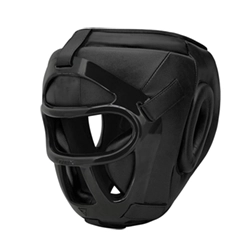 Headgear
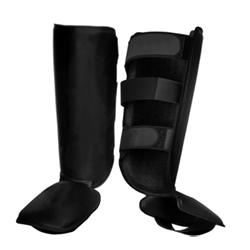 Shin-instep guard
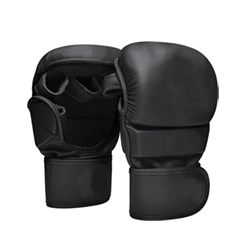 Gloves
Note: Fighters who don’t have the required protective equipment will not be permitted to fight and will not be refunded their entry fees.
Competition format:
All matches are single elimination. Lose and you are eliminated. Win and you advance to the next bracket.
Match Length (running time unless there is an injury or equipment malfunction):
In Case of a tie in the Little Dragons and Kids Category, the first to score wins the match.
In Case of a tie in the Juniors, Teens, & Adults Categories, there will be a 30-second Sudden-Death to determine the winner.
Scoring:
Progression of match:
Legal contact targets:
Legal non-contact targets
NOTE: The above targets require good control since any excessive contact to these areas will result in immediate disqualification.
Allowable techniques:
Illegal techniques:
The following infractions will result in a warning:
The following will result in immediate disqualification:
NOTE: By definition, light contact sparring implies that strikes and kicks must be of a tagging nature and NOT of a jarring nature executed with heavy impact force!
NOTE: All Sparring Divisions must have at least 2 competitors for a match to take place. If not, the competitors will be moved to the nearest weight class and skill level or spar in an exhibition match.
We will notify you before the competition if we cannot match you with another competitor with similar weight and skill level.
NOTE: ALL REACTION SKILLS ARE LIMITED TO A MAXIMUM OF 50 YEARS OF AGE. THIS INCLUDES LIGHT CONTACT CONTINUOUS SPARRING, PUSH HANDS, CHI SAO, AND POINT MMA.
A formal procedure must be followed when a competitor or instructor would like to launch a protest regarding a presumed discrepancy in the application of the rules.
An Arbitration Official will be assigned for each tournament. Do Not Approach the Promoter for matters pertaining to Arbitration as your request will be immediately disallowed with no further recourse.